
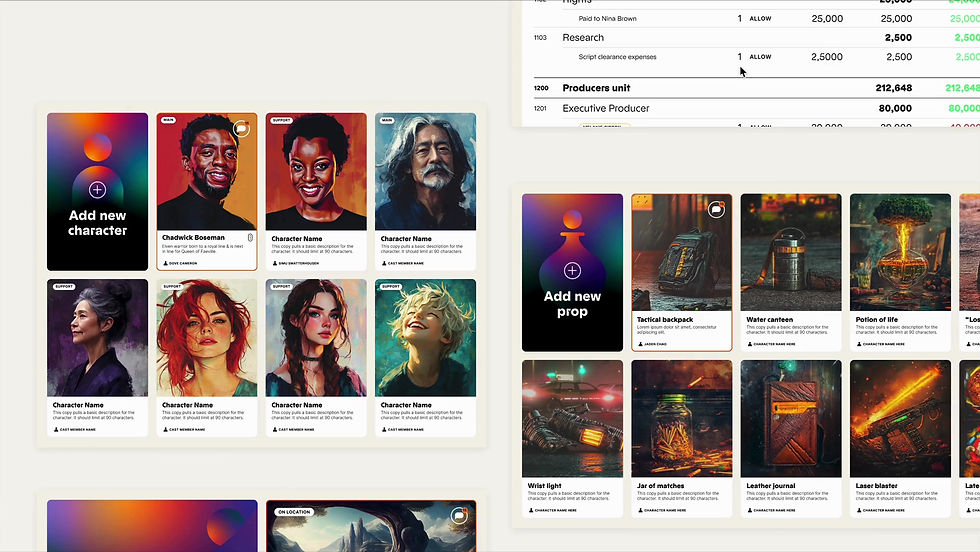
AI powered visualization tool for filmmakers
Product Design @ StudioEngine
Bringing costumes to AI-generated characters in film production
ROLE
Product Design Intern
TEAM
Creative Director
Systems Engineer
SKILLS
Systems Thinking
Product Design
User Stories
Rapid Prototyping
Vibe Coding
TIMELINE
20 days
July 2025
TOOLS
Figma
Figjam
Lovable
CONTEXT
Films have been around since the early 1880s, but the way they’re made has constantly evolved. Now AI is transforming how stories are imagined, scripted, and visualized.

StudioEngine Film is an AI-powered production system that supercharges film creation through scripting, visuals, organized workflows and schedules. The pre-visualization phase of visualizing concept art, scenes, characters, sets and props is extensive and time consuming. StudioEngine’s Film AI creator tool fastracks this whole process.
OPPORTUNITY
Characters without costumes are unfinished, like Black Panther showing up in khakis. We needed a wardrobe system to complete the story.


Casting and character art only go so far. Costumes and styling are essential for shaping identity, world building (like Wakanda), and to pitch film ideas. Adding a wardrobe feature not only filled this gap but also differentiated StudioEngine from competitors by giving creators a complete visualization toolkit.
CORE VALUES
Leveling the film field with a tool for anyone who has a story to tell, from seasoned professionals to scrappy indie teams to curious students.

StudioEngine had to flex across extremes: domain experts with decades of experience, small indie crews juggling multiple roles, and learners just discovering the craft. The wardrobe feature needs to bridge across, helping each group translate half-formed ideas, or even detailed styling visions into tangible, production-ready assets.
Lowering the learning curve while keeping the capability
New creator tools and AI assistants launch every month, but many are intimidating for newcomers or too shallow for experts. StudioEngine aimed to be instantly approachable while retaining depth, much like Canva made graphic design accessible, Figma redefined collaboration, and Runway simplified media creation.
DESIGNING THE WARDROBE SYSTEM
Costumes can’t exist in isolation. They must reflect the film’s world, the scene, and character

Wardrobes draw on a web of story cues. I designed a prompting system that linked costumes to narrative context, so a character’s banquet attire and battle gear differed by scene but remained stylistically consistent. This ensured all of a character’s costumes felt like part of a single, coherent wardrobe.
Mirroring real creative workflows with a layered wardrobe system

Costume design is rarely one-and-done. I translated the process into modular layers: an overall wardrobe style (parent), specific costume pieces (children), construction details to align designers and technical teams, hair & makeup, and accessories. Users could regenerate or lock any layer, or mix and match elements across costumes, reducing redundancy while mirroring the iterative workflow of professional costume designers.
Balancing flexibility and guidance for different workflows and skillsets

Some users want AI to chime in as a thought partner, while others demanded granular control over fabrics and seams. The design supports both, beginner-friendly modes to finer controls, while also enabling smooth team collaboration.
Using AI tokens wisely so creators don’t have to worry about them

The wardrobe system was designed to optimize token usage automatically. Users got the most out of their subscriptions without micromanaging resources, while the business controlled costs at scale, a true win-win.
IMPACT
Scaled efficiency for both users and the company

Accelerated creative workflows - Transformed costume ideation from a manual process into an AI-assisted flow, reducing user design time by over 3 hours per costume and helping creators focus on storytelling.
Scaled efficiency across product teams - Designed a modular framework replicable across four feature sets and three product lines, saving 280+ design and development hours and improving design-dev collaboration.
REFLECTION
Designing without domain knowledge, learning through curiosity, and shaping what AI-native creation looks like
Learning the language of film - With no background in film or costume design, I dove in by stepping into the shoes of stylists, directors and film students with user research, reading production guides, and studying creative workflows.
Prototyping has never been faster - Lovable and Figma Make let me prototype faster, visualize wireframes, and explore a wide range of directions before narrowing down.
Designing for AI-native creation - An incredible opportunity to help shape how creators imagine and make things. I learnt a lot about balancing AI control and human creativity.